
OCD & Intrusive Thoughts
When your mind gets stuck on thoughts you don’t want.
Obsessive-compulsive disorder can involve much more than being neat, organized, or particular.
For many people, OCD is an exhausting cycle of unwanted thoughts, doubts, images, urges, or fears—followed by behaviors or mental rituals meant to reduce the anxiety those thoughts create.
You may know that the fear doesn't make sense and still feel unable to let it go. You may repeatedly check, seek reassurance, review conversations in your mind, avoid certain situations, or perform rituals until things feel “right.”
OCD can become incredibly time-consuming and isolating, but effective treatment is available. Therapy can help you better understand the OCD cycle, reduce the power of intrusive thoughts, and change the patterns that keep anxiety going.
What Can OCD Feel Like?
OCD often involves two related experiences: obsessions and compulsions.
Obsessions are unwanted thoughts, images, urges, doubts, or fears that repeatedly enter your mind and create distress. Compulsions are behaviors or mental actions you feel driven to perform in order to reduce that distress, prevent something bad from happening, or make things feel “right.”
Intrusive Thoughts and Obsessions
You may experience:
Repeated thoughts that something bad could happen
Fear that you may have made a serious mistake
Doubts about whether you locked a door, turned something off, or completed something correctly
Unwanted violent, sexual, religious, or disturbing thoughts
Fear that having a thought means something about who you are
Persistent concerns about contamination, germs, illness, or chemicals
An intense need for certainty
Repeated doubts about relationships, decisions, morality, or identity
Feeling responsible for preventing harm
A need for things to feel exact, complete, symmetrical, or “just right”
Intrusive thoughts can feel especially frightening because they often focus on the things a person cares about most.
Having an unwanted thought does not mean you want it to happen or that it reflects your character.
Compulsions and Rituals
Compulsions aren't always obvious.
Some involve visible behaviors, while others happen entirely in your mind.
You may find yourself:
Checking locks, appliances, messages, work, or other things repeatedly
Washing or cleaning excessively
Repeating actions until they feel correct
Counting, tapping, arranging, or performing tasks in a particular order
Asking other people for reassurance
Confessing thoughts or seeking confirmation that you did nothing wrong
Re-reading messages, emails, or conversations
Mentally reviewing events to make sure something didn't happen
Repeating words, phrases, prayers, or thoughts in your mind
Trying to replace a “bad” thought with a “good” one
Searching online repeatedly for reassurance
Avoiding people, places, objects, media, or situations that trigger intrusive thoughts
Compulsions often bring temporary relief. Unfortunately, that relief can reinforce the cycle and make the urge to perform the compulsion stronger the next time anxiety appears.
OCD Can Create a Need for Certainty
One of the most difficult parts of OCD can be the feeling that you need to know something with complete certainty.
You might find yourself asking:
“What if I missed something?”
“What if I hurt someone?”
“What if this thought means something?”
“What if I made the wrong decision?”
“What if I never feel completely sure?”
Because absolute certainty is rarely possible, the search for reassurance can become endless.
OCD Can Affect Daily Life
OCD can interfere with work, school, sleep, relationships, parenting, driving, leaving the house, decision-making, and everyday routines.
Some people spend hours each day performing rituals or mentally reviewing situations. Others appear completely functional on the outside while experiencing constant intrusive thoughts and mental compulsions internally.
OCD does not have to look severe from the outside to be exhausting to live with.
The OCD Cycle
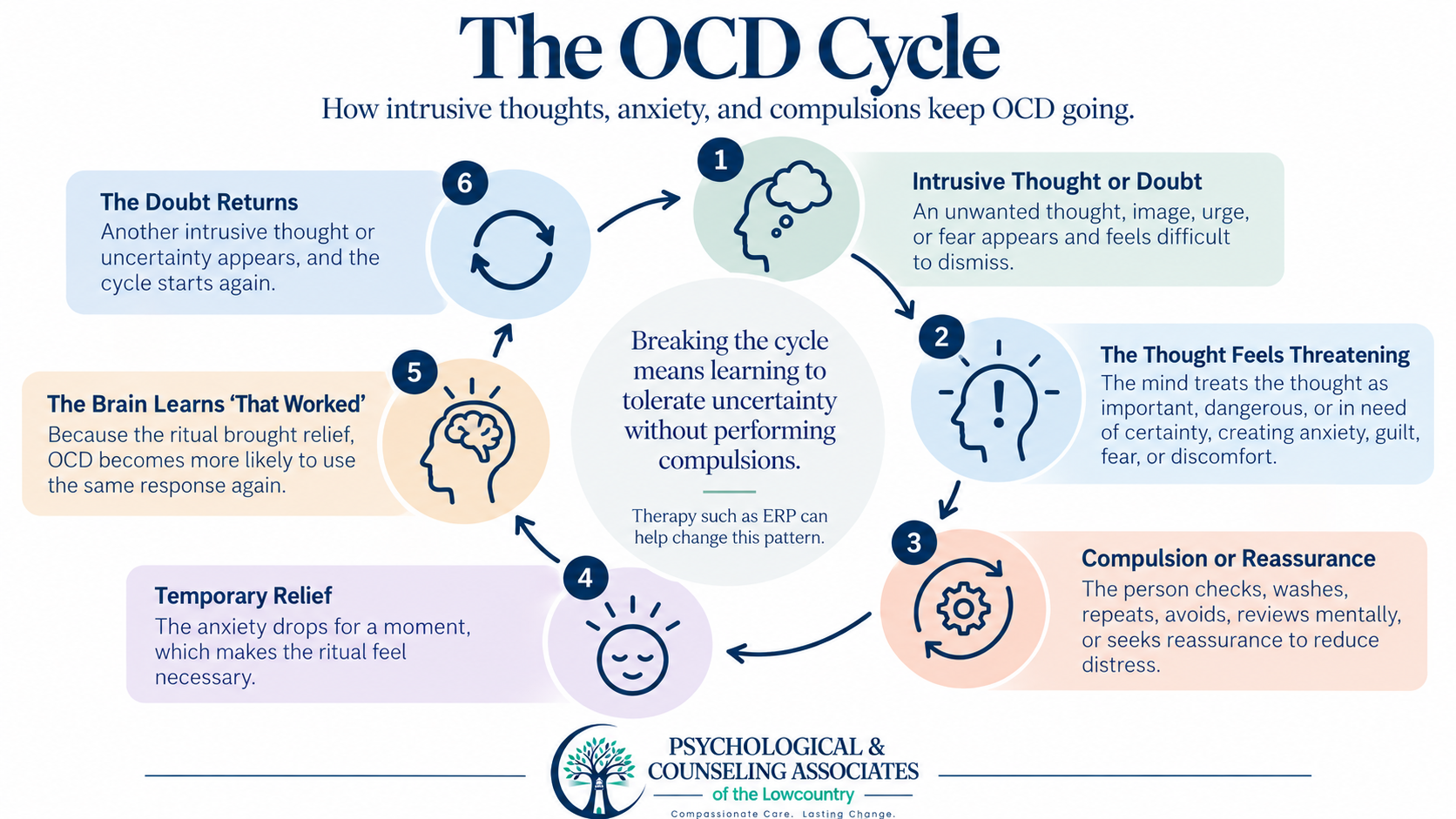
OCD often continues because of a repeating cycle between intrusive thoughts, anxiety, compulsions, and temporary relief.
1. An Intrusive Thought or Doubt Appears
A thought, image, urge, memory, physical sensation, or question enters your mind.
It might be:
“What if I left the door unlocked?”
“What if I accidentally hurt someone?”
“What if I said something inappropriate?”
“What if I'm contaminated?”
“What if this thought means something about me?”
Most people experience strange or unwanted thoughts from time to time. With OCD, however, the thought can feel unusually important, dangerous, or difficult to dismiss.
2. The Thought Feels Threatening
Your mind begins trying to determine what the thought means and whether there is any possibility that something bad could happen.
You may feel anxiety, guilt, disgust, fear, uncertainty, or an intense sense that something simply isn't right.
The more important it feels to resolve the doubt, the harder it can become to let the thought pass.
3. You Perform a Compulsion
To reduce the discomfort or gain certainty, you may perform a behavior or mental ritual.
That might include:
Checking something again
Washing or cleaning
Asking someone for reassurance
Searching online for answers
Reviewing a conversation or memory repeatedly
Confessing something
Repeating an action until it feels right
Mentally analyzing the thought
Avoiding whatever triggered the anxiety
The compulsion may feel necessary even when part of you recognizes that it is excessive.
4. Anxiety Temporarily Decreases
After completing the compulsion, you may feel relief.
The door seems safe.
Your hands finally feel clean.
Someone reassures you that you didn't do anything wrong.
You convince yourself that the intrusive thought doesn't mean anything.
For a moment, the anxiety decreases.
5. The Brain Learns That the Compulsion “Worked”
This temporary relief is what can keep the OCD cycle going.
Your brain learns:
“I felt anxious. I performed the ritual. Then I felt better.”
That makes you more likely to perform the same compulsion the next time doubt or anxiety appears.
Unfortunately, the brain never gets the opportunity to learn that the anxiety could have decreased on its own—or that the feared outcome may not have required preventing in the first place.
6. The Doubt Returns
Eventually another intrusive thought, sensation, or uncertainty appears.
Sometimes it is the same fear.
Sometimes OCD finds a new question.
And because the previous compulsion provided temporary relief, the urge to check, analyze, avoid, or seek reassurance can become even stronger.
Over time, the cycle can consume increasing amounts of time and attention.
Breaking the OCD Cycle
Effective treatment for OCD focuses on changing the response to intrusive thoughts rather than trying to guarantee that the thoughts never occur.
Approaches such as Exposure and Response Prevention (ERP) can help people gradually face uncertainty or anxiety without performing the compulsions that normally provide temporary relief.
Over time, this can help the brain learn an important lesson:
You can experience uncertainty or anxiety without having to respond to it with a ritual.
Common Forms of OCD
OCD can focus on almost any subject. The specific fear may vary from one person to another, but the underlying pattern is often similar: an intrusive thought or doubt creates distress, followed by an attempt to gain certainty, prevent something bad from happening, or make the discomfort go away.
Some common OCD themes include:
Contamination OCD
Contamination fears may involve germs, illness, bodily fluids, chemicals, household products, food, public spaces, or the feeling that something is simply “dirty.”
Compulsions may include excessive handwashing, showering, cleaning, changing clothes, avoiding objects or places, separating “clean” and “contaminated” items, or repeatedly asking whether something is safe.
Checking OCD
Checking OCD often involves persistent doubt about whether something was done correctly or whether a mistake could cause harm.
You may repeatedly check:
Doors, locks, appliances, or electrical devices
Emails, messages, paperwork, or assignments
Whether you accidentally injured someone
Whether you made a serious mistake
Whether something happened the way you remember it
Checking may provide temporary certainty, but the doubt often returns.
Harm OCD
Harm OCD can involve unwanted thoughts, images, or fears about hurting yourself or someone else—even when you have no desire or intention to do so.
These thoughts can be extremely upsetting precisely because they conflict with your values and who you believe yourself to be.
Someone experiencing harm OCD may avoid knives, driving, being alone with loved ones, watching certain media, or other situations that trigger intrusive thoughts. They may also repeatedly analyze their thoughts or seek reassurance that they are not dangerous.
Relationship OCD
Relationship OCD can involve persistent doubts about a romantic relationship or your feelings toward your partner.
You might repeatedly ask yourself:
“Do I really love them?”
“What if I'm with the wrong person?”
“What if someone else would be better?”
“What if this relationship isn't right?”
Compulsions may include constantly evaluating your feelings, comparing your relationship to others, testing your attraction, analyzing your partner's qualities, or repeatedly asking others for reassurance.
Religious or Moral OCD
Sometimes called scrupulosity, this form of OCD involves intense fears about morality, religion, sin, ethics, or being a “bad” person.
Someone may repeatedly review past behavior, confess, pray, seek reassurance, avoid situations that create moral uncertainty, or become consumed with determining whether a thought or action was completely acceptable.
“Just Right” OCD
Not every OCD experience centers on fear that something terrible will happen.
Some people experience intense discomfort when something doesn't feel complete, balanced, symmetrical, exact, or “just right.”
You may repeat an action, rearrange something, reread a sentence, rewrite something, touch objects in a particular way, or continue a task until you experience the feeling that it has been completed correctly.
Health-Related OCD
Health-related OCD can involve persistent fears about having or developing an illness.
You may repeatedly check your body, research symptoms online, seek reassurance from others, schedule repeated medical evaluations, or avoid medical information entirely because it triggers anxiety.
Although health concerns can sometimes resemble other forms of health anxiety, OCD often involves a repeating pattern of intrusive doubt and compulsive attempts to obtain certainty.
Sexual Intrusive Thoughts
OCD can produce unwanted sexual thoughts, images, sensations, or doubts that feel disturbing or inconsistent with a person's values or identity.
The presence of an intrusive thought does not establish desire or intent.
Because these thoughts can create shame or fear, people may spend significant amounts of time analyzing what the thoughts mean, monitoring their reactions, testing themselves, avoiding certain people or situations, or seeking reassurance.
OCD Doesn't Always Look Like OCD
Some compulsions are easy for other people to see. Others happen entirely inside someone's mind.
A person may appear calm and functional while spending hours mentally reviewing memories, analyzing thoughts, checking feelings, seeking certainty, or trying to determine what an intrusive thought “really means.”
The content of OCD can change over time. What tends to remain consistent is the cycle of doubt, distress, compulsive attempts to gain certainty, temporary relief, and the eventual return of doubt.
How Can Therapy Help With OCD?
Treatment for OCD is not about learning how to eliminate every intrusive thought.
Trying to suppress, analyze, disprove, or gain complete certainty about unwanted thoughts can sometimes become part of the OCD cycle itself.
Instead, therapy can help you change the way you respond to intrusive thoughts, anxiety, and uncertainty so that compulsions become less necessary and OCD has less influence over your life.
Exposure and Response Prevention (ERP)
Exposure and Response Prevention, often called ERP, is a well-established form of therapy used to treat OCD.
ERP involves gradually and intentionally facing thoughts, situations, sensations, or uncertainties that trigger anxiety while reducing the compulsions normally used to make that anxiety go away.
For example, someone who repeatedly checks whether a door is locked might practice leaving after checking it once rather than returning again and again.
Someone who constantly asks others for reassurance might practice tolerating uncertainty without asking the question.
Someone experiencing intrusive thoughts may learn to allow the thought to be present without analyzing it, trying to cancel it out, or proving that it does not mean anything.
ERP is typically approached gradually. Treatment is not about overwhelming you or forcing you to confront your greatest fear immediately. You and your therapist can work together to develop exercises that challenge OCD while remaining appropriate to your treatment goals.
Learning to Tolerate Uncertainty
OCD often demands certainty:
“Can I be absolutely sure?”
“What if there is still a chance?”
“How do I know this thought doesn't mean something?”
Unfortunately, complete certainty is rarely available.
Therapy can help you become more comfortable allowing some uncertainty to exist without responding with checking, reassurance, avoidance, or mental analysis.
The goal is not to convince yourself that nothing bad could ever happen. It is to develop greater confidence in your ability to live your life without needing OCD to provide an impossible guarantee.
Reducing Compulsions
Compulsions can feel helpful because they often reduce anxiety temporarily.
Therapy helps identify both obvious and less visible compulsions—including checking, washing, reassurance seeking, avoidance, researching, confessing, reviewing memories, analyzing thoughts, and other mental rituals.
As you gradually reduce these behaviors, your brain has an opportunity to learn that anxiety can decrease without performing the ritual.
Over time, the urge to respond compulsively can become less powerful.
Changing Your Relationship With Intrusive Thoughts
Intrusive thoughts are not necessarily the problem.
The difficulty often comes from the importance OCD assigns to them.
Therapy can help you practice noticing an unwanted thought without automatically treating it as a warning, a prediction, or evidence about who you are.
Instead of repeatedly asking, “Why did I think that?” or “What does this mean about me?” you can learn to recognize the thought for what it is and decide whether it deserves your attention.
Getting Back to the Life OCD Has Interrupted
OCD can gradually shape everyday decisions—where you go, what you touch, who you spend time with, what you avoid, how long ordinary tasks take, and how much reassurance you need before moving forward.
Treatment is ultimately about more than reducing symptoms.
It is about helping you spend less time responding to OCD and more time participating in the relationships, activities, responsibilities, and experiences that matter to you.
Common Questions About OCD and Intrusive Thoughts
Why do I have intrusive thoughts I don't want?
Unwanted thoughts, images, and impulses are common human experiences. Having an intrusive thought does not necessarily mean that you agree with it, want it to happen, or intend to act on it.
With OCD, however, an unwanted thought may feel unusually important or threatening. Instead of passing through your mind, it can trigger questions such as, “Why did I think that?” or “What if this means something about me?”
Trying to completely resolve those questions can sometimes make the thought feel even more significant.
Do intrusive thoughts mean I secretly want them?
An intrusive thought by itself does not establish desire, intention, or character.
In OCD, intrusive thoughts are often particularly upsetting because they conflict with the person's values. The distress may then lead to repeatedly analyzing the thought, checking emotional reactions, avoiding triggers, or asking others for reassurance.
Therapy can help you change the way you respond to intrusive thoughts rather than repeatedly trying to prove what they do or do not mean.
Why do I keep checking things even when I know they're fine?
Checking can temporarily reduce uncertainty.
You may know that you locked the door, turned off the stove, sent the correct email, or completed a task correctly—but OCD introduces another possibility:
“What if I didn't?”
Checking again may provide relief, but that relief can teach your brain to rely on checking whenever doubt appears. Over time, you may feel less confident in your own memory and increasingly dependent on checking for reassurance.
Why do I keep asking people for reassurance?
Reassurance can function much like other compulsions.
Questions such as “Are you sure everything is okay?” “Do you think I did something wrong?” or “Does this thought mean I'm a bad person?” may temporarily reduce anxiety.
Unfortunately, certainty rarely lasts. Another doubt often appears, leading to another question.
Therapy can help you recognize reassurance seeking and gradually become more comfortable allowing uncertainty to exist without repeatedly needing someone else to resolve it.
Can OCD be mostly thoughts without obvious compulsions?
Yes.
Some people with OCD have few compulsions that other people can see. Instead, compulsions may occur mentally.
These can include repeatedly reviewing memories, analyzing thoughts, checking feelings, silently repeating words or phrases, trying to replace unwanted thoughts, mentally proving that something is safe, or repeatedly trying to determine what a thought “really means.”
Because these rituals happen internally, OCD may be difficult for other people to recognize.
What is harm OCD?
Harm OCD refers to obsessive fears or intrusive thoughts involving the possibility of hurting yourself or someone else.
A person may experience unwanted images, thoughts, or impulses that are deeply upsetting and inconsistent with what they actually want.
They may respond by avoiding certain objects or situations, reviewing their behavior, checking memories, monitoring their reactions, or repeatedly seeking reassurance that they are not dangerous.
A qualified mental health professional can help distinguish obsessive fears from other concerns and determine an appropriate treatment approach.
What is relationship OCD?
Relationship OCD, sometimes called ROCD, involves persistent obsessive doubt involving romantic relationships.
Someone may repeatedly question whether they truly love their partner, whether their partner is right for them, whether they find their partner attractive enough, or whether another relationship would be better.
The person may constantly monitor feelings, compare their relationship to others, analyze their partner's characteristics, or repeatedly seek reassurance.
Normal relationship questions can occur in any relationship. With OCD, the repeated need to achieve certainty can become distressing and difficult to disengage from.
What is religious or moral OCD?
Religious or moral OCD is often referred to as scrupulosity.
It may involve excessive fear of committing a sin, violating a moral rule, offending God, behaving unethically, or discovering that you are secretly a bad person.
Compulsions can include repeated prayer, confession, reviewing past behavior, seeking reassurance from religious leaders or others, avoiding morally uncertain situations, or repeatedly analyzing whether something was right or wrong.
The problem is not necessarily the person's religious or moral beliefs. The OCD cycle develops around the demand for complete certainty.
Can OCD make me doubt my memories?
Yes. OCD can cause people to repeatedly question whether they remember something correctly.
You may know what you remember but begin asking:
“What if I'm remembering it wrong?”
“What if something happened and I forgot?”
“What if I did something without realizing it?”
Trying to reconstruct the event repeatedly can actually make confidence in the memory weaker rather than stronger.
This pattern is sometimes described as memory checking or may occur within what people informally call “false memory OCD.”
Why do I keep Googling the same question?
Repeated online research can sometimes become a form of reassurance seeking.
You may search a symptom, thought, fear, moral question, relationship concern, or health issue and initially feel better after finding an answer.
Then another doubt appears.
You search again, read another article, check another discussion, or slightly change the wording of the question hoping to finally achieve certainty.
When searching becomes part of the OCD cycle, the issue may no longer be a lack of information—the problem may be the need to feel completely certain.
Why does OCD keep changing what I worry about?
OCD does not have to remain focused on one subject.
Someone may struggle with contamination concerns at one point and later become preoccupied with relationships, health, morality, harm, or another theme.
Although the content changes, the underlying cycle can remain remarkably similar:
Doubt → distress → attempt to gain certainty → temporary relief → more doubt.
Treatment therefore focuses not only on the particular topic but also on changing the pattern that allows OCD to keep attaching itself to new uncertainties.
Does trying not to think about something make intrusive thoughts worse?
It can.
When you make a strong effort not to think about something, you may begin monitoring your mind to determine whether the thought has returned.
That monitoring can make the thought more noticeable.
OCD treatment generally does not depend on successfully preventing intrusive thoughts. Instead, therapy can help you allow thoughts to occur without automatically analyzing them, fighting them, or responding with a compulsion.
What is ERP therapy?
Exposure and Response Prevention (ERP) is a form of cognitive behavioral therapy commonly used in the treatment of OCD.
Exposure involves gradually encountering situations, thoughts, sensations, or uncertainty that trigger OCD.
Response prevention involves practicing not performing the compulsion normally used to reduce the resulting discomfort.
With repeated practice, people can learn that they are capable of experiencing anxiety and uncertainty without relying on rituals to make those feelings disappear.
Is ERP supposed to make me extremely anxious?
ERP is not intended to simply overwhelm someone with their greatest fear.
Treatment is generally planned collaboratively and can progress gradually based on the person's symptoms, goals, and readiness.
The purpose is to create meaningful opportunities to practice responding differently to OCD—not to create unnecessary distress.
Can therapy actually help OCD?
Yes. Evidence-based psychotherapy, particularly approaches that include Exposure and Response Prevention, is widely used in the treatment of obsessive-compulsive disorder.
Therapy can help identify obsessions and compulsions, reduce reassurance seeking and avoidance, increase tolerance of uncertainty, and help you respond differently when intrusive thoughts occur.
Treatment should be individualized because OCD can look very different from one person to another.
How do I know if I should see a therapist about OCD?
It may be worth seeking professional help if intrusive thoughts, checking, cleaning, reassurance seeking, avoidance, mental reviewing, or other rituals are consuming significant time or interfering with everyday life.
You might also consider therapy if you recognize that a behavior is excessive but still feel unable to stop, or if you are increasingly organizing your life around avoiding thoughts, situations, or uncertainty.
You do not need to know for certain that you have OCD before speaking with a mental health professional. An evaluation can help clarify what you are experiencing and what type of treatment may be appropriate.
OCD Treatment in Bluffton & Hilton Head Island, SC
Psychological & Counseling Associates of the Lowcountry provides therapy for OCD, intrusive thoughts, compulsive behaviors, and related anxiety concerns at our Bluffton and Hilton Head Island locations.
OCD can look very different from one person to another. Some people struggle with visible behaviors such as checking, washing, or repeating. Others experience primarily intrusive thoughts, reassurance seeking, mental reviewing, avoidance, or an ongoing need for certainty.
Our clinicians work with you to understand the patterns affecting your life and develop an individualized treatment approach based on your symptoms, goals, and needs.
Ready to Talk With Someone?
You do not need to have every symptom figured out—or even be certain that what you're experiencing is OCD—before reaching out.
If intrusive thoughts, compulsions, reassurance seeking, or persistent doubt are taking up more of your life than you want them to, we can help you determine the next step.